It started as a dull ache. The kind you ignore for a few days because life is busy and teeth are… well, teeth. Until one morning, that ache turned into a sharp, pulsing pain that made sipping coffee impossible. That tooth was waving a white flag. Or so it seemed.
This is the story of how a root canal didn’t ruin a smile. It saved it.
When a Tooth Is in Trouble, and You Can’t Ignore It Anymore
Teeth are tough. They put up with a lot. Hot coffee. Ice cream. Late-night snacking. The occasional missed flossing session. But even the strongest tooth has a breaking point.
Inside every tooth is soft tissue called the pulp. It holds nerves and blood vessels. When bacteria sneak in through a deep cavity, a crack, or old dental work, that pulp can become inflamed or infected. That’s when the pain shows up.
At first, it might feel manageable.
A twinge when you bite down.
Sensitivity to cold that lingers a little too long.
A strange pressure you can’t quite explain.
Then it escalates.
Pain that wakes you up at night.
Swelling around the gums.
A bad taste that won’t go away.
That’s the moment many people think, “This tooth is done for.”
But not so fast.
Why Pulling the Tooth Isn’t Always the Best Answer
When pain hits hard, extraction can sound tempting. Get it out. End the problem. Move on.
The thing is, losing a tooth creates a whole new set of problems.
Teeth don’t like gaps. When one tooth goes missing, the surrounding teeth slowly shift—your bite changes. Chewing becomes uneven. Jaw strain can sneak in. Over time, bone loss may follow.
Replacing a tooth later with an implant or bridge takes time, planning, and cost.
Saving the natural tooth, when possible, is almost always the better move. That’s where a root canal comes in.
What a Root Canal Really Does
Let’s clear something up right away.
A root canal does not cause pain.
It relieves it.
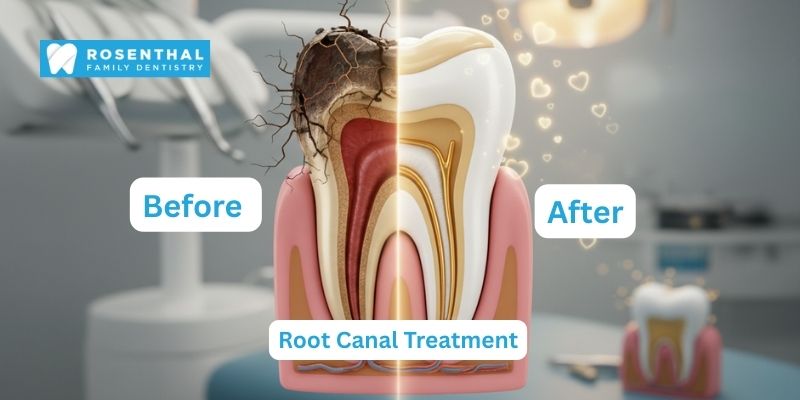
The procedure removes the infected or damaged pulp inside the tooth. Once that tissue is gone, the dentist cleans and shapes the inner canals. These spaces are then filled and sealed to prevent bacteria from coming back.
The outer structure of the tooth stays right where it is.
Same tooth. Same spot. New lease on life.
Most people are surprised by how uneventful the process feels. Local anesthesia does its job. Modern tools are precise. The scary stories floating around usually date back decades.
That Moment When Relief Finally Hits
There’s a moment after a root canal that patients don’t forget.
The pain is gone.
Not slowly fading. Just… gone.
That constant throbbing pressure disappears. The tooth finally calms down. For many people, it feels like a reset button was pressed.
And yes, there might be some soreness afterward. That’s normal. The surrounding tissues need a little time to settle. But compared to the pain that brought them in, it’s minor.
Why Crowns Often Follow Root Canals
After a root canal, the inside of the tooth is no longer alive. That means the tooth can become more brittle over time.
To protect it, dentists often recommend a crown.
Think of a crown as a helmet for your tooth. It covers the entire surface, restores strength, and helps the tooth function like it should. You can chew normally. Smile normally. Forget that tooth ever caused trouble in the first place.
Skipping the crown can put the tooth at risk of cracking later. That’s one of the main reasons root canals fail over time. Not the procedure itself, but the lack of protection afterward.
Common Myths That Still Scare People Away
Root canals have a reputation they don’t deserve. Let’s talk about a few myths that still make the rounds.
“Root canals are extremely painful.”
The pain comes from the infection, not the treatment. Most patients say it feels similar to getting a filling.
“It’s better to just pull the tooth.”
Extraction may seem quicker, but it creates long-term issues. Saving your natural tooth usually leads to better function and fewer complications.
“Root canals do not last.”
That’s not true. Your root canal-treated tooth can last for many years with adequate care and a crown. It can even last a lifetime.
“If it doesn’t hurt anymore, it must be fine.”
Pain can disappear even when an infection is still present. Waiting too long can allow damage to spread to the bone.
Signs a Tooth Is Crying for Help
Some warning signs are apparent. Others are sneaky.
Pay attention if you notice:
- Lingering sensitivity to hot or cold
- Pain when biting or chewing
- Swollen or tender gums near a tooth
- A pimple-like bump on the gums
- Darkening of a tooth
- Pain that comes and goes without reason
Even one of these is worth getting checked. Early treatment often means a more straightforward procedure and a better outcome.
What Happens If You Wait Too Long?
Ignoring a failing tooth doesn’t make it stronger.
Infections don’t stay put. They spread. The bacteria can move beyond the tooth into the surrounding bone. In severe cases, it can lead to abscesses, facial swelling, and systemic issues.
At that point, saving the tooth may no longer be possible.
That’s why dentists push early intervention. Not to scare you. To protect you.
Life After a Root Canal
Once everything heals and the crown is in place, most people forget which tooth had the work done.
You eat normally.
You brush and floss like usual.
You go back to your routine.
There’s no special maintenance beyond good oral hygiene and regular dental visits. The treated tooth becomes just another part of your smile again.
And something is reassuring about knowing that a tooth that was once on the brink didn’t give up.
The Bigger Picture: Saving Teeth Whenever Possible
Dentistry today is about preservation. The goal is not to remove teeth but to keep them healthy for as long as possible.
A root canal is one of the best examples of that philosophy. It steps in at the last moment. It takes a tooth that looks like a lost cause and gives it another chance.
That matters more than most people realize.
Your natural teeth are designed specifically for your bite, your jaw, and your face. Nothing replaces them quite the same way.
So, Was the Tooth Really “Almost Gone”?
From the outside, it looked bad. Pain. Infection. Frustration.
But inside, that tooth just needed help.
A root canal didn’t just stop the pain. It stopped a chain reaction of future problems. It kept the smile intact. It kept chewing comfortably. It kept things simple.
Sometimes, saving something is the quiet win you don’t appreciate until much later.
And that tooth?
- It’s still there.
- Still working.
- Still doing its job.
Not bad for something that almost gave up.